






















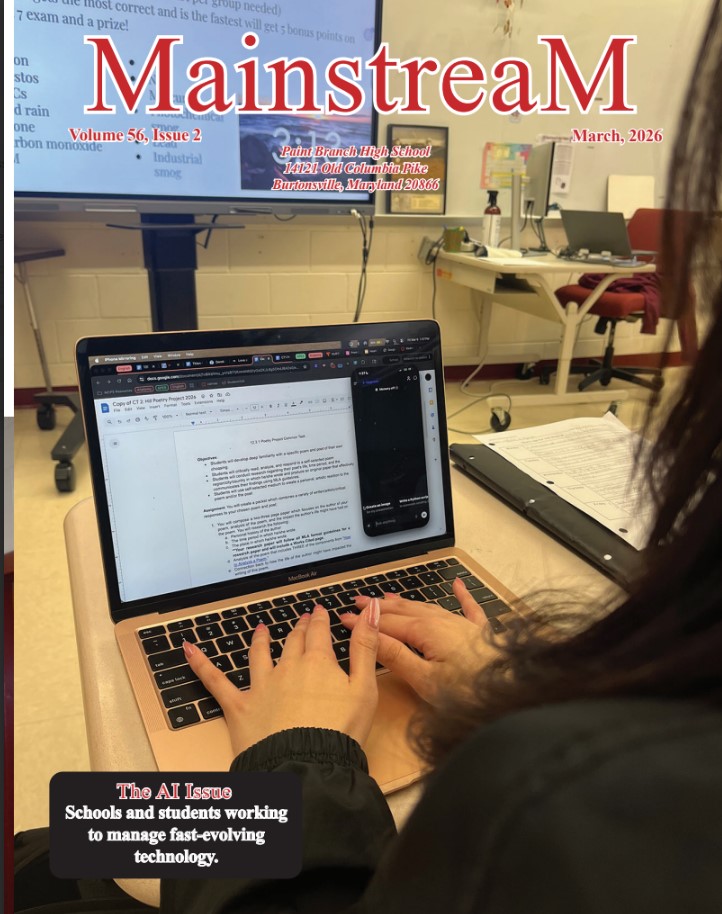




Student use of Artificial Intelligence (AI) is an important topic. Some argue that it is bad for students and leads to cheating, while others argue that it is helpful to both students and teachers and provides another tool for learning. AI may help students when their teachers may not give them what they need to grasp the material.
AI provides students the easiest, fastest, and most direct answers to questions they have, and provides explanations that help them better understand content. This allows students to save time when doing research or get brainstorming ideas, so they have more time to finish challenging or detailed assignments. This type of AI support with questions and research helps students work faster and more efficiently, which can boost their grades and overall understanding. AI also allows students to organize their study material such as notes, which can be a great benefit when they are backed up with work. Additionally, students who have been out of school for a longer period of time can use AI to catch up more quickly.
According to the Digital Education Council, “86% of students globally are regularly using AI in their studies.” The Council, which works with universities and colleges throughout the world, notes that ChatGPT is the most widely-used AI tool for students. Gauth, which provides visual and structured answers, is another AI tool used by students. Unlike ChatGPT, which is considered a general-purpose chatbot, Gauth is designed to solve homework problems through photo uploads.
Anwesha Panda’s article “Should AI be Your Friend?,” for The Teen Magazine states that a benefit students get from AI is that it can offer students 24/7 tutoring and instant feedback. Anytime a student doesn’t get something, they can head straight to AI to get the help and answers they need. With the feedback they get from AI, students can improve their understanding of content, make changes or corrections to their work, and improve academically.
Panda’s article also states that ChatGPT can do just about anything you need it to, from high level math like calculus to translating languages. This means that for today’s students, course content is easier to find which improves learning. Panda notes that with this kind of technology and intelligence at our fingertips 24/7, it means that we can learn on our own schedule. This is good for students because when they finish their work on time or with greater understanding because of the help they got from AI, it can impact other areas of their lives including after school activities such as sports, clubs, and work.
Adam Granados, a freshman at Blake High School, finds AI to be a very helpful and useful tool. When Adam doesn’t have time to take notes and study, he “asks AI for a quick rundown on the subject” he is learning about. Adam also says that since he asks AI to help him out with his notes it gives him “more time for any other important work” he has to get done. He states that any time he has a question about what he is learning “AI goes way more in-depth and explains way better than Google does.” He says that this helps him because AI gives him straightforward answers and explanations. That way he can understand things more efficiently and be more confident when he is doing his work.
Although AI can be helpful in many ways, it can also present issues for students. One area is too much reliance on AI. The Digital Education Council reports that 54% of teens use AI on a weekly basis, which could lead to students not doing their own work. This is something that concerns schools because it leads to learning loss. Jennifer Vilcarino and Lauraine Langreo of Education Week report that “Seventy percent of teachers worry that AI weakens critical thinking and research skills.”
Overuse of AI, particularly on tests, quizzes, and projects, by students can lead to academic dishonesty. Students use AI in their work when something is too difficult for them to understand or when they want to get the work done quickly. When students become too reliant on AI, their school skills can start to weaken. Critical thinking capacity weakens because students ask AI to do all of their problem solving. As Vilcarino and Langreo of Education Week note, students’ research skills start to weaken and they start to lose their originality and writing skills. With AI always giving them straight-forward answers and solutions, students’ creativity and critical thinking suffers, because they rely so much on it to do the work for them.
While AI use among students is extremely common, teachers also use it for a variety of reasons. Some of the ways teachers use AI include managing timing of lessons, finding information to help students understand content, and modifying vocabulary and readings to support students. These methods help them provide students with additional support and useful feedback to avoid confusion and help them learn content more fully.
According to Mrs. Bloom, an English teacher at Paint Branch, AI allows teachers to find information faster. She states, “Certain lessons and assignments require teachers to gather all kinds of materials to use for lessons. In the past, gathering materials could take hours,” which is why she uses AI resources to gather material faster and easier. She also uses AI so she can find articles that were written for teens and not adults which can help her work “smarter, not harder.”
Another area that AI helps with is condensing lesson content to fit 40-minute class periods, something that Mrs. Bloom says can be hard to do with so much content to cover. She says that she sometimes asks “ChatGPT to create a schedule” for a lesson so she knows how long to spend on each slide. Since she says that when planning it might not look long but when she teaches it, it takes longer than she has expected.
Ms. Andrade, an English Language Development teacher at Paint Branch, states that she uses AI to help her students with stories they read for class. She notes that AI can help her “focus on short excerpts to help students understand what is happening in the story.” AI also helps Ms. Andrade adjust complex vocabulary into words that students are more familiar with. AI “has been a very helpful tool” for Ms. Andrade, since it helps simplify things for her students.
Students having good relationships with their teachers and peers is very important, which is what traditional schooling brings. In this type of environment, if they have questions about something they don’t get, they go to their teachers and peers. When students look to AI to solve things, this is taken away. The balance between AI use and traditional school structure is something that students, teachers, and schools must figure out moving forward.